
For years, one of the most frustrating parts of healthcare has happened after the patient leaves the room. The visit may be over, but the work is not. Clinicians still have to turn the conversation into a note, update the chart, capture follow-up instructions, document medical decision-making, and make sure the record is accurate enough for the rest of the care team to use.
That hidden workload is one reason ambient AI has become one of the fastest-moving areas in healthcare technology. The promise is simple: let the clinician focus more on the patient conversation while AI helps draft the documentation in the background.
Now, that promise is being tested at a much bigger scale. The U.S. Department of Veterans Affairs awarded an Ambient Scribe Enterprise IDIQ contract with a five-year ordering period and a shared maximum ceiling of $775.72 million across awarded contracts. According to the official award notice, the contract is for cloud-based ambient scribe tools that can transcribe clinical encounters, generate notes, and support other AI functionality meant to improve the efficiency of medical care. SAM.gov
Abridge announced that it was selected to provide ambient AI under the VA enterprise contract through its distribution partner. The company said its platform is already operational on both VA electronic health record systems: VistA/CPRS and the Federal EHR. Abridge also said it is serving thousands of VA clinicians at more than 75 VA medical centers. Abridge
This is not just another healthcare AI announcement. It is a sign that ambient AI is moving from pilot programs into the infrastructure of care. The question is no longer only whether AI can draft a note. The bigger question is whether healthcare can use this technology in a way that gives clinicians time back, protects patient trust, and keeps the medical record accurate.
The real problem is not typing. It is attention.
Ambient AI is often described as “AI that writes the note,” but that explanation is too small. The real problem is attention. Clinicians are expected to listen carefully, ask the right questions, build trust, check the chart, document accurately, manage quality measures, order next steps, and make the patient feel seen, often during the same short visit.
That is where the patient experience can suffer. A visit can start to feel less like a conversation and more like a race between the patient’s story and the computer screen. Ambient AI tries to change that workflow by listening during the visit, with consent and according to the organization’s rules, then creating a draft note for the clinician to review, edit, and sign.
The goal is not to remove the clinician from the process. The goal is to reduce the time clinicians spend acting like data-entry systems so they can spend more of the visit actually present with the patient.
Why the VA rollout matters
The VA is not a small test environment. It is one of the largest healthcare systems in the country, serving veterans across many care settings, specialties, regions, and technology environments. That scale makes this rollout important because ambient AI will have to work across real-world clinical complexity, not just a controlled demo.
Abridge said its platform is already live in primary care, across a dozen specialties, and in VA Clinical Resource Hubs, the VA’s virtual care network. That matters because documentation needs are not the same in every visit. A primary care check-in, a cardiology appointment, a behavioral health conversation, and a virtual care visit can all require different clinical context and different note structure. Abridge
The VA’s technology environment also adds another layer of complexity. Abridge said it is operational across both of the VA’s major EHR environments, including the legacy VistA/CPRS system and the Federal EHR. That detail matters because one of the hardest parts of healthcare AI is not making the tool look impressive. It is getting the tool to work inside existing clinical workflows, old systems, new systems, privacy requirements, and real patient care. Healthcare IT News
If ambient AI can work across a system as large and complex as the VA, it could influence how other health systems think about AI documentation, procurement, governance, clinician adoption, and patient transparency.
What patients may notice
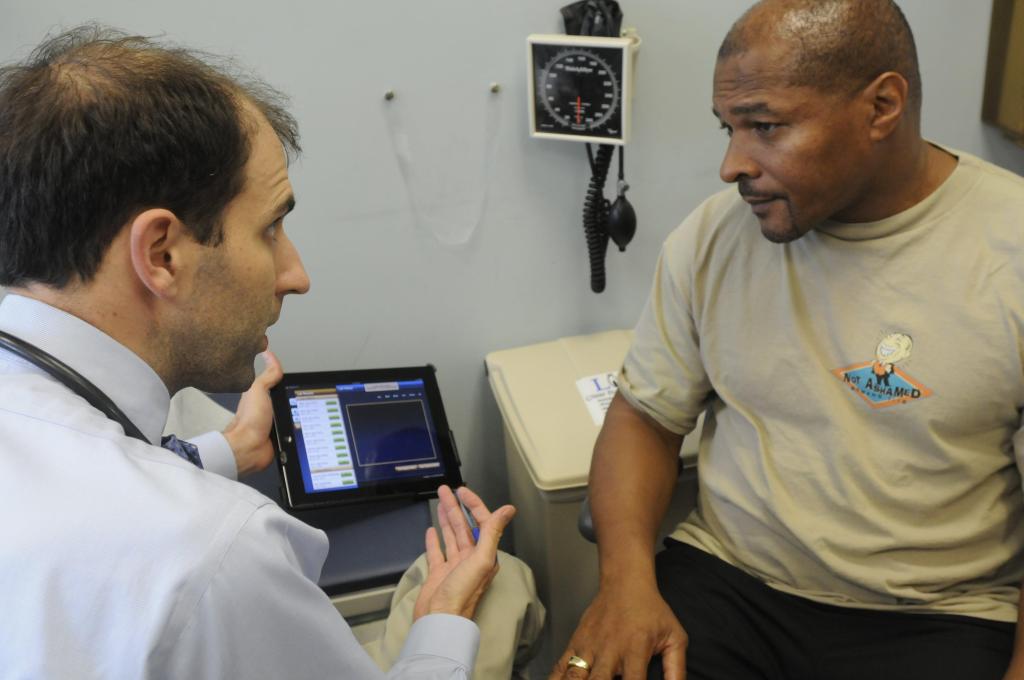
Patients may not care what an ambient scribe is called. They may care that the clinician looks at them more and the screen less. That is the patient-facing promise of this technology. If it works well, the visit may feel more like an actual conversation, with the clinician able to listen, ask follow-up questions, and stay present instead of constantly trying to capture every detail manually.
But there is also a patient trust issue here. Patients deserve to know when AI is being used, what is being captured, how their information is protected, and whether the note is reviewed by a clinician before it becomes part of the medical record. Ambient AI should not feel invisible to the patient. It should feel transparent.
The business story behind the technology
This is also a major Business of Healthcare story. A five-year federal contract ceiling of $775.72 million shows that ambient AI is no longer just a startup pitch or a small innovation pilot. It is becoming an enterprise healthcare purchasing category.
The official VA award notice describes the contract as a multiple-award IDIQ, which means awarded vendors can compete for task orders under the broader contract ceiling. That distinction matters. The headline number does not mean one company automatically received $775.72 million. It means the VA created a large purchasing vehicle for ambient scribe technology across awarded contracts. SAM.gov
Still, the message to the market is clear. Health systems are no longer only asking whether ambient AI is impressive. They are asking whether it can be deployed, governed, integrated, and scaled. That is a different stage of maturity for healthcare AI.
What could go wrong
Ambient AI has real promise, but the risks are real too. A draft note can be wrong. A detail can be missed. A medication can be misunderstood. A symptom can be summarized too vaguely. A conversation can be turned into a clinical note that sounds polished but loses nuance.
That is why clinician review is not optional. It is the safety layer. AI can draft, organize, and support the documentation process, but the clinician still has to verify what becomes part of the medical record.
There are also privacy questions. Patients need clarity about consent, data storage, audio handling, vendor access, and whether recordings are retained or deleted. These questions become even more important when the technology is deployed inside a large public healthcare system.
The safest framing is this: ambient AI should support documentation. It should not quietly become the clinician.
Why this is bigger than burnout
A lot of AI scribe coverage focuses on clinician burnout, and that is fair. Documentation burden is a serious problem. But the larger opportunity may be care quality. If a clinician has more time and attention during the visit, the patient may share more. If the note is more complete, handoffs may improve. If the follow-up plan is clearer, patients may leave with better instructions. If documentation happens faster, the care team may have access to information sooner.
That is the best-case scenario. The worst-case scenario is that AI simply helps healthcare move faster without becoming clearer, safer, or more human. The difference will come down to implementation.
What to watch next
The next phase of this story is not just whether more clinicians use ambient AI. It is whether ambient AI improves the parts of care that patients and clinicians actually feel.
- Whether clinicians continue using the tools after the novelty wears off
- How much time is saved outside clinic hours
- Whether note accuracy improves or creates a new review burden
- How patient consent is handled
- Whether the tools work across specialties, not just primary care
- How systems measure safety, privacy, and documentation quality
- Whether AI-generated notes make follow-up care clearer
The technology is moving fast. The evaluation needs to move just as carefully.
The bottom line
The VA’s ambient AI contract is one of the clearest signs yet that AI documentation is moving from pilot projects into healthcare infrastructure. Abridge, Carahsoft, and the U.S. Department of Veterans Affairs are now part of a much larger test: can AI help clinicians spend less time documenting and more time caring, without sacrificing accuracy, privacy, or trust?
That is the real story. Not that AI can write a note, but that healthcare is starting to redesign the visit around the conversation again.
Want to stay informed on the latest in healthcare? Subscribe to the UpNEX Health blog and get notified when new articles are published!
FAQs
What is ambient AI in healthcare?
Ambient AI is technology that can listen to a clinician-patient conversation, then draft clinical documentation for the clinician to review, edit, and sign.
What did the VA award?
The VA awarded an Ambient Scribe Enterprise IDIQ contract with a five-year ordering period and a shared maximum ceiling of $775.72 million across awarded contracts.
Did one company receive the full $775.72 million?
No. The contract is a multiple-award IDIQ with a shared ceiling, meaning awarded vendors can compete for task orders under the broader contract limit.
Where is Abridge being used in the VA?
Abridge says its platform is already operational on both VA EHR systems and serving thousands of clinicians at more than 75 VA medical centers.
Why does ambient AI matter for patients?
If implemented well, ambient AI may help clinicians spend less time typing and more time focused on the patient conversation. Patients should still be told when AI is being used and how their information is protected.
Can AI-generated notes make mistakes?
Yes. AI-generated notes can miss details, summarize too vaguely, or include errors. That is why clinicians still need to review, edit, and sign the final note.
Sources and References
Abridge. “Abridge Selected to Bring Ambient AI to Veteran Care Nationwide Through the VA Enterprise Contract.” Abridge, 22 September 2026, https://www.abridge.com/press-release/va-enterprise-contract.
Fox, Andrea. “Abridge Ambient AI Now Available to All VA Medical Centers.” Healthcare IT News, 23 September 2026, https://www.healthcareitnews.com/news/abridge-ambient-ai-now-available-all-va-medical-centers.
U.S. Department of Veterans Affairs. “Ambient Scribe Enterprise IDIQ Award Notice.” SAM.gov, 18 September 2026, https://sam.gov/opp/d8a636ff239345d3ada0ee196c7a8717/view.


