Pulse oximeters are one of the most familiar devices in healthcare. You have probably seen one clipped onto a finger at a doctor’s office, urgent care, hospital, or even at home.
The number it gives looks simple: blood oxygen saturation (the percentage of oxygen in your blood, indicating how well oxygen is being delivered to your body’s organs and tissues).
But the technology behind that number has had a serious problem for years.
Studies have shown that pulse oximeters can miss low oxygen levels more often in patients with darker skin. That means a person may appear to have a safer oxygen reading than they actually do, delaying care when oxygen levels are dangerously low.
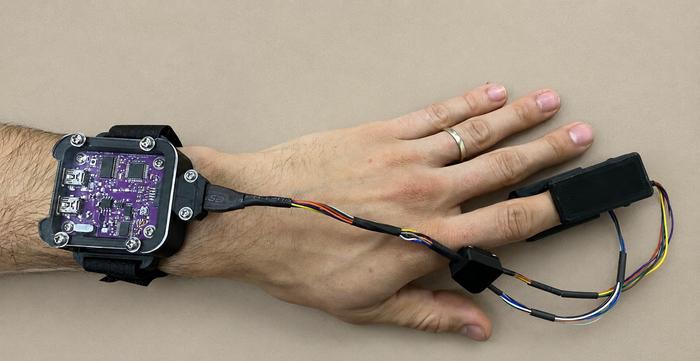
Now, researchers at Tufts University have developed a prototype called ChromaSense, a wrist-worn pulse oximeter designed to adjust to a person’s skin reflectance before measuring oxygen saturation. In other words, instead of pretending every patient’s skin interacts with light the same way, the device tries to account for those differences directly.
That may sound like a small engineering detail……It is not.
It could be a sign of where medical devices need to go next: not just smarter, but more accurate across the people they are actually meant to serve.
The problem hiding inside a common device
Pulse oximeters estimate blood oxygen by using light. Traditional fingertip devices send red and infrared light through tissue, then calculate oxygen saturation based on how much light is absorbed.
The issue is that skin is not invisible to light.
Melanin can absorb and scatter light, which can interfere with the signal used to estimate oxygen levels. For patients with darker skin pigmentation, this can contribute to measurement error.
This matters most when oxygen levels are already low. A small error may not seem dramatic on paper, but in clinical care, oxygen numbers help guide decisions like whether a patient needs closer monitoring, supplemental oxygen, blood gas testing, hospital admission, or escalation of care.
A 2020 New England Journal of Medicine analysis found that Black patients had nearly three times the frequency of occult hypoxemia compared with White patients. Occult hypoxemia means the pulse oximeter looked reassuring, but the blood oxygen level measured by arterial blood gas was actually low.
So the concern is not that pulse oximeters are useless.
The concern is that a tool used everywhere may not work equally well for everyone.
What makes ChromaSense different
ChromaSense is not just a regular pulse oximeter moved from the finger to the wrist.
The device uses a reflectance-based wearable photoplethysmography sensor, also called PPG. Instead of transmitting light through a fingertip, it reads light reflected from tissue at the wrist. It also includes spectral colorimetric sensing, which helps estimate skin reflectance and adjust the LED drive current and signal processing around that individual user.
In plain language: the device first pays attention to the skin it is measuring through.
Medical devices often assume the body is a standard surface. ChromaSense is built around the idea that the body is not standard, and the device should adapt.
What the study found
The Tufts team evaluated ChromaSense in a cohort of 50 participants spanning the Fitzpatrick skin tone scale. For oxygen saturation, the device achieved a root-mean-square accuracy of 1.36% compared with an FDA-cleared reference pulse oximeter, satisfying the ISO 80601-2-61:2013 standard requirement. The study also found no statistically significant difference in oxygen measurement error across Fitzpatrick skin types.
Medical Economics reported that testing included induced hypoxia in healthy volunteers, with oxygen levels briefly lowered across a 70% to 100% saturation range and compared against reference measurements. The outlet also noted that the device showed no observable tone-dependent bias in that setting, but is not commercially available and still needs validation in clinical populations.
That last part matters.
This is promising research, not a product patients can buy today.
Why this is bigger than one wearable
The FDA has already been pushing for better pulse oximeter performance across skin tones. In January 2025, the agency proposed updated recommendations intended to generate more representative performance data for medical pulse oximeters across the range of skin pigmentation.
That broader regulatory attention is important because the problem is not just technical. It is also about trust.
Patients expect medical devices to work the same way for everyone. Clinicians expect the numbers on the monitor to be reliable enough to guide care. But when a device performs differently across skin tones, that can quietly widen health disparities.
ChromaSense is part of a larger shift: medical technology can no longer be considered “neutral” just because it is a machine.
The way a device is designed, tested, calibrated, and validated matters.
What this could mean for patients
For patients, a more equitable pulse oximeter could eventually mean more reliable oxygen readings during respiratory illness, hospital monitoring, home care, sleep tracking, chronic disease management, and remote patient monitoring.
But it is important not to jump too far ahead.
ChromaSense is still a prototype. The study was conducted in a controlled setting with healthy volunteers, not a broad real-world hospital population. It still needs larger validation in patients with different diseases, different perfusion levels, movement, darker and lighter skin tones, and real clinical conditions.
A device can perform well in a study and still need more work before it is ready for everyday care.
That is not a weakness. That is how responsible innovation moves forward.
The real lesson
This story is not only about a pulse oximeter.
It is about what happens when healthcare stops treating bias as a communication problem and starts treating it as a design problem.
For years, the conversation around pulse oximeter bias has focused on warning clinicians to interpret readings carefully. That is important, but it puts a lot of responsibility on the person using the device.
ChromaSense points to a different approach: build devices that account for human variation from the beginning.
That is what makes this innovation worth watching. Not because it is ready to replace every pulse oximeter tomorrow.
Because it asks the right question:
What if medical devices were built to see every patient accurately from the start?
Want to stay informed on the latest in healthcare? Subscribe to the UpNEXHeath blog and get notified when new articles are published!
FAQs –
What is ChromaSense?
ChromaSense is a prototype wrist-worn pulse oximeter developed by Tufts researchers. It is designed to measure vital signs, including blood oxygen saturation, while adapting to differences in skin reflectance.
Why do pulse oximeters have issues with skin tone?
Pulse oximeters use light to estimate oxygen saturation. Melanin can absorb and scatter light, which may distort readings in people with darker skin pigmentation.
What problem is ChromaSense trying to solve?
It is trying to reduce skin-tone-related measurement bias by estimating a person’s skin reflectance and adjusting the device’s light output and signal processing.
Is ChromaSense available to patients?
No. Medical Economics reported that the device is not commercially available yet and still needs validation in clinical populations.
Did the study show it worked across skin tones?
The published study found no statistically significant difference in oxygen measurement error across Fitzpatrick skin types in the evaluated cohort.
Why does this matter in healthcare?
Pulse oximeter readings can influence clinical decisions. If a device misses low oxygen levels more often in some patients, it can contribute to delayed care and health disparities.
Sources and References
Durbha, Ravi, and Valencia Koomson. “A Reflectance-Based Multimodal Wearable Photoplethysmography (PPG) Sensor.” Review of Scientific Instruments, 22 June 2026, https://doi.org/10.1063/5.0304023.
Littrell, Austin. “FDA Proposes Mandatory Notice for Food Additives; Biden Cancer Update; Pulse Oximeter Tunes Itself to Skin Tone — Morning Medical Update.” Medical Economics, 11 August 2026, https://www.medicaleconomics.com/view/fda-proposes-mandatory-notice-for-food-additives-biden-cancer-update-pulse-oximeter-tunes-itself-to-skin-tone-morning-medical-update.
Sjoding, Michael W., Robert P. Dickson, Theodore J. Iwashyna, Steven E. Gay, and Thomas S. Valley. “Racial Bias in Pulse Oximetry Measurement.” The New England Journal of Medicine, 17 December 2020, https://www.nejm.org/doi/full/10.1056/NEJMc2029240.
Tufts University School of Engineering. “A Researcher from Associate Professor Valencia Koomson’s Advanced Integrated Circuits and Systems Lab Demonstrates the EquiVitals Device.” Koomson Named Finalist in Oximetry Challenge, 21 November 2023, https://engineering.tufts.edu/news-events/news/koomson-named-finalist-oximetry-challenge.
U.S. Food and Drug Administration. “FDA Proposes Updated Recommendations to Help Improve Performance of Pulse Oximeters Across Skin Tones.” FDA, 6 January 2025, https://www.fda.gov/news-events/press-announcements/fda-proposes-updated-recommendations-help-improve-performance-pulse-oximeters-across-skin-tones.
U.S. Food and Drug Administration. “Pulse Oximeters.” FDA, updated 6 January 2025, https://www.fda.gov/medical-devices/products-and-medical-procedures/pulse-oximeters.


 UPNEX HEALTH
Leave a comment