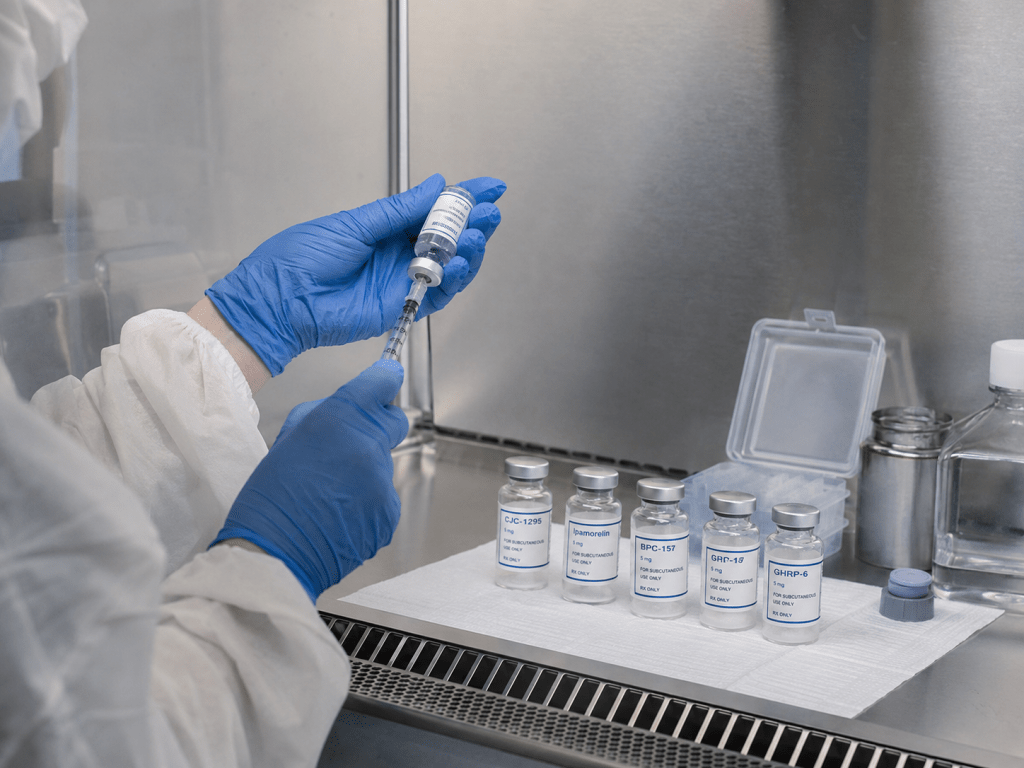
Peptides have been everywhere lately.
They show up in wellness clinics, biohacking podcasts, gym recovery conversations, longevity forums, med spas, and online communities where people talk about healing faster, sleeping better, reducing inflammation, improving skin, building muscle, or “optimizing” their body.
Now, they are also at the center of a major FDA debate.
On July 23 and 24, the FDA’s Pharmacy Compounding Advisory Committee met to review seven peptide-related bulk drug substances for possible use by compounding pharmacies under the 503A bulk drug substances pathway. The peptides discussed included BPC-157-related substances, KPV-related substances, TB-500-related substances, MOTs-C-related substances, Emideltide-related substances, Semax-related substances, and Epitalon-related substances.
Then came the part that made headlines: the advisory committee recommended easing restrictions on six unapproved peptides, going against FDA staff concerns that there was not enough evidence to support broader compounding access.
That does not mean these peptides are suddenly FDA-approved.
It does not mean they are proven safe for the wellness claims being made online.
And it definitely does not mean people should start injecting products they find through gray-market sellers.
But it does mean the peptide market may be entering a new phase, and patients need to understand the difference between access, approval, evidence, and hype.
The part everyone is getting wrong
The biggest misunderstanding is simple: a compounding recommendation is not the same thing as FDA approval.
A compounded drug is made by a licensed pharmacist, physician, or outsourcing facility for specific patient needs. Compounding can be important when a patient cannot use an FDA-approved drug as manufactured, such as someone who needs a dye-free version because of an allergy or someone who needs a liquid form because they cannot swallow a pill.
But FDA says compounded drugs are not FDA-approved. That means FDA does not verify their safety, effectiveness, or quality in the same way it does for approved medications. FDA also warns that poor compounding practices can lead to serious quality problems, including contamination or drugs that do not have the strength, quality, or purity they are supposed to have.
That distinction matters because the peptide conversation online often blurs the line.
A clinic saying a peptide is “available” is not the same as saying it is approved.
A pharmacy being able to compound something is not the same as a drug completing the traditional FDA approval process.
And a peptide being popular does not automatically mean it has strong human evidence behind every claim being made about it.
Why are peptides so popular right now?
Peptides are short chains of amino acids. Some peptides are used in approved medicines, and researchers have studied peptides for a wide range of potential medical uses. But the current wellness boom is not only about approved peptide drugs.
The hype is coming from a different world: recovery, performance, anti-aging, inflammation, skin, injury healing, longevity, sleep, and metabolic optimization.
Some of the peptides discussed by the FDA advisory panel, like BPC-157 and TB-500, are especially popular in fitness and recovery circles. Others, like Semax or Epitalon, are often promoted online for brain, sleep, aging, or longevity-related claims. Allure reported that the July meeting focused on seven injectable peptides, including BPC-157, KPV, and Epitalon, and noted that many of these compounds have circulated through online gray markets.
That is where this gets tricky.
There may be real scientific interest in peptides. There may also be patients using them already, sometimes without medical supervision or from sources that label products “for research use only.”
But popularity is not the same thing as proof.
What actually changed?
The FDA advisory committee’s vote is a recommendation, not a final FDA decision.
The committee reviewed whether these peptide-related bulk drug substances should be added to the 503A bulk drug substances list. FDA explains that a substance can appear on the 503A bulks list when there is no applicable USP or NF monograph and the substance is not a component of an FDA-approved drug product.
Reuters reported that advisers backed broader access to six unapproved peptides, even though FDA staff said there was not sufficient evidence to support loosening compounding restrictions.
The Guardian reported that FDA said it is considering the committee’s recommendations and will make a final decision after consulting with the United States Pharmacopeia and reviewing other available information.
So for patients, the most accurate takeaway is:
The door may be opening, but it has not fully opened yet.
The safety issue patients should not skip
FDA has raised safety concerns about some compounded peptide-related substances. For instance, they warn that compounded drugs with BPC-157 might cause immune reactions when taken in certain ways and might have issues related to impurities and the characterization of active pharmaceutical ingredients. Additionally, FDA has pointed out risks for TB-500 due to aggregation and related impurities.
That does not mean every peptide product is dangerous.
It does mean this is not a casual supplement conversation.
Injectable products raise extra concerns because sterility, dose accuracy, impurities, and source quality matter. A poorly made or contaminated injectable product can cause serious harm. FDA’s compounded drug risk guidance states that compounded drugs that fail to meet quality standards, such as being contaminated or containing too much active ingredient, could cause serious injury or death.
That is why patients should be cautious about any clinic, influencer, or seller making sweeping claims like:
“FDA-approved peptide therapy”
“No risks”
“Works for everyone”
“Research-backed for anti-aging”
“Safe because it’s compounded”
“Doctor-formulated, so no need to worry”
Those phrases should raise questions, not close them.
What patients should ask before considering peptide therapy
This is not medical advice, and patients should always talk with a licensed clinician who understands their full health history.
But if a peptide is being offered, these are reasonable questions to ask:
- Is this peptide FDA-approved for the condition being treated?
- If it is compounded, where is it being compounded?
- Is the pharmacy state-licensed or registered as an outsourcing facility?
- What human evidence supports this specific use?
- What dose, route, and duration are being recommended?
- What side effects or immune reactions are possible?
- What monitoring is needed?
- Could it interact with my medications or health conditions?
- What happens if I have an adverse reaction?
- Are the claims being made supported by clinical trials, or mostly by anecdote?
A good clinician should be able to answer those questions without brushing them off.

Why this moment matters
Healthcare has a trust problem. People are frustrated with rushed visits, high costs, long waits, and feeling dismissed. That creates the perfect environment for wellness markets to move quickly.
Peptides are becoming popular partly because they promise something patients want: healing, control, performance, youth, energy, and answers.
But healthcare history has taught us that when demand moves faster than evidence, patients can become the experiment.
That is the tension here.
More regulated access could be safer than people buying mystery vials online. But broader access without strong evidence could also turn a gray-market trend into a polished cash-pay industry before patients fully understand the risks.
Both things can be true.
The bottom line
The FDA advisory panel’s peptide vote could reshape the market for compounded wellness therapies.
But for patients, the message should be careful, not hype-driven. A peptide becoming easier to compound is not the same as being FDA-approved. A wellness clinic offering it is not the same as a clinical trial proving it works. And an influencer talking about recovery, longevity, or inflammation is not the same as a clinician explaining risks, evidence, and monitoring.
Peptide therapy may continue moving closer to mainstream healthcare.
The question is whether evidence, safety, and patient protection will keep up.
Watch the FDA Pharmacy Compounding Advisory Committee meeting where advisers discussed peptide-related substances and compounding access.
Want to stay informed on the latest in healthcare? Subscribe to the UpNEXHeath blog and get notified when new articles are published!
FAQs –
Are these peptides FDA-approved now?
No. An FDA advisory committee recommendation is not the same as FDA approval. FDA has not approved these peptides for the broad wellness claims often made online.
What did the FDA advisory committee recommend?
The committee recommended easing restrictions on six of seven peptide-related substances reviewed for possible compounding access under the 503A pathway.
What is drug compounding?
Drug compounding is when a pharmacist, physician, or outsourcing facility combines, mixes, or alters drug ingredients to meet a specific patient need.
Are compounded drugs FDA-approved?
No. FDA says compounded drugs are not FDA-approved, meaning FDA does not verify their safety, effectiveness, or quality the same way it does for approved drugs.
Why are people using peptides?
Peptides are being promoted for recovery, inflammation, skin, longevity, sleep, performance, and other wellness uses. Some claims may have early research interest, but many uses being promoted online do not have strong human evidence.
What should patients ask before trying peptide therapy?
Patients should ask whether the peptide is FDA-approved for their condition, what evidence supports the use, where it is compounded, what side effects are possible, and what monitoring is needed.
Sources and References
U.S. Food and Drug Administration. “July 23-24, 2026: Meeting of the Pharmacy Compounding Advisory Committee.” FDA, 23-24 July 2026, https://www.fda.gov/advisory-committees/advisory-committee-calendar/july-23-24-2026-meeting-pharmacy-compounding-advisory-committee-07232026.
U.S. Food and Drug Administration. “July 24, 2026 Meeting of the Pharmacy Compounding Advisory Committee (PCAC).” YouTube, 24 July 2026, https://youtube.com/live/xXM5ecHxlMU?feature=share.
U.S. Food and Drug Administration. “Understanding the Risks of Compounded Drugs.” FDA, https://www.fda.gov/drugs/human-drug-compounding/understanding-risks-compounded-drugs.
U.S. Food and Drug Administration. “Consumer and Health Care Professional Information.” FDA, https://www.fda.gov/drugs/human-drug-compounding/consumer-and-health-care-professional-information.
U.S. Food and Drug Administration. “Bulk Drug Substances Used in Compounding.” FDA, https://www.fda.gov/drugs/human-drug-compounding/bulk-drug-substances-used-compounding.
Reuters. “FDA Advisers Recommend Relaxing US Rules on Compounding Peptides.” Reuters, 24 July 2026, https://www.reuters.com/legal/litigation/fda-advisers-weigh-relaxing-rules-three-more-peptides-widen-access-2026-07-24/.
The Guardian. “‘It’s a Peptide Wild West’: How RFK Jr Is Clearing Way for a Market of Untested Drugs.” The Guardian, 30 July 2026, https://www.theguardian.com/us-news/ng-interactive/2026/jul/30/peptide-fda-rfk-jr-drug-regulation.
Allure. “An FDA Advisory Panel Voted to Ease Restrictions on 6 Controversial Peptides. Here’s What That Means.” Allure, 28 July 2026, https://www.allure.com/story/peptides-meeting-july-2026.


 UPNEX HEALTH
Leave a comment