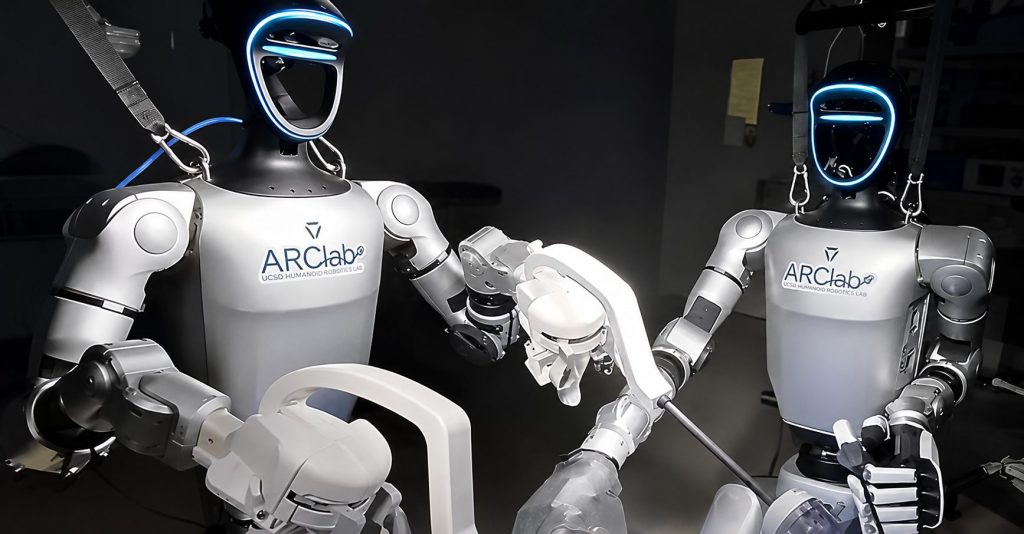
Humanoid robots have officially stepped into one of healthcare’s most demanding environments: the operating room.
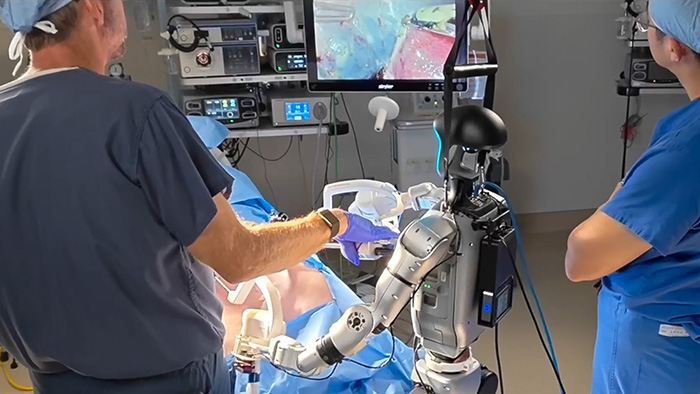
Researchers and surgeons at the University of California San Diego reported that two teleoperated humanoid robots were used to complete two live surgeries in a preclinical study, published July 8 in Nature. The procedures were gallbladder removals performed in large non-primate mammals (not humans). In one procedure, a humanoid robot worked with a human surgeon assistant. In another, two humanoid robots worked side by side.
That sounds futuristic, but the most important detail is this: these robots were not operating independently on human patients. They were remotely controlled by human surgeons, and the work is still early.
Still, the study is getting attention because it points to a bigger question in healthcare innovation: could humanoid robots one day help expand access to surgery, especially in places where specialized surgical robots, large operating rooms, or full surgical teams are harder to access?
Let’s break down what happened, what “Surgie” actually did, and why this could matter for the future of care.
Overview of Events
The UC San Diego team used remote-controlled humanoid robots called “Surgie” to carry out laparoscopic gallbladder removal surgery in a test study. Laparoscopic surgery is a type of surgery that makes small cuts in the body and uses long tools, usually guided by a camera, to perform the procedure.
According to UC San Diego, the first operation involved a human-robot team, with one humanoid robot operating while a human surgeon assisted. The second involved two humanoid robots working together in a robot-robot team. Both procedures were completed in large non-primate mammals.
This is a proof-of-concept study, meaning researchers were testing whether the idea could work at all, not whether the system is ready for routine clinical use.
The response so far is that it worked, but it’s not quite ready for prime time.
Why Use a Humanoid Robot for Surgery?
Most people already know about surgical robots like the da Vinci Surgical System. These are highly specialized platforms designed for precise, minimally invasive surgery. They can be powerful, but they are expensive, large, and not equally available across all healthcare settings.
Humanoid robots are different. They are built with a human-like form: arms, hands, mobility, and the ability to operate in spaces already designed for people. That matters because hospitals, operating rooms, and field care environments were not built around machines. They were built around humans.
UC San Diego researchers said one of the advantages of a humanoid robot is that it can fit more naturally into the operating room workflow. The team did have to create adapters so Surgie could hold traditional surgical tools, but researchers noted that the robot’s form factor allowed it to work in a space that already looks and functions like a human surgical environment.
In plain terms: instead of redesigning the entire room around the robot, the robot may eventually be able to adapt to the room.
What Does “Teleoperated” Mean?
Teleoperated means the robot is controlled by a human operator from a console or remote system. The robot is not making independent surgical decisions. It is acting as an extension of the surgeon’s movements.
This matters because headlines can make it sound like humanoid robots are now autonomously operating on patients. That is not what happened here.
The UC San Diego study evaluated humanoid robots in surgical tasks under human control. Researchers are interested in future autonomy, but this study is best understood as a step toward robotic assistance, remote surgical support, and future operating room teamwork between humans and machines.
The current vision is not necessarily “robots replacing surgeons.”
It is more likely, at least in the near term, that humanoid robots could become surgical assistants, tool handlers, remote extensions of expert surgeons, or support systems in locations where staffing is limited.
Why This Matters for Healthcare Access
This story is not only about robotics. It is about access.
The U.S. is projected to face a physician shortage of up to 86,000 physicians by 2036, according to the AAMC. Surgical access is also uneven, with rural, underserved, military, disaster response, and low-resource settings facing added barriers.
That is where humanoid robots become interesting.
A typical high-end surgical robot may require a large footprint, specialized setup, and significant capital investment. A smaller humanoid platform could, in theory, be more portable, easier to deploy, and more adaptable to different environments.
UC San Diego researchers specifically pointed to possible future use cases in rural areas, battlefield medicine, and even space. They also noted that humanoid robots may eventually help with tasks beyond surgery itself, such as fetching tools, assisting teams, or cleaning up an operating room after a procedure.
That does not mean every small hospital will have a humanoid surgeon tomorrow.
But it does suggest a future where surgical expertise could travel differently. Instead of always moving patients to specialty centers, some care could eventually be supported through remote expertise, robotic assistance, and adaptable surgical platforms.
The Technology Is Promising, But Not Ready Yet
There are still major hurdles.
UC San Diego researchers reported that the robots had to be recalibrated several times during surgery. That made the procedures take longer than they would with current specialized surgical robotic systems. Latency, or the delay between the surgeon’s movement and the robot’s response, is another issue researchers are working to improve.
These details matter because surgery leaves very little room for error.
For humanoid robots to move from preclinical studies to real-world care, they will need to demonstrate reliability, precision, safe response times, strong fail-safes, clean integration with surgical workflows, and clear human oversight.
They will also need to answer questions like:
- Who is responsible if something goes wrong?
- How should teams be trained to work with humanoid robots?
- What safety standards should apply?
- How will hospitals validate performance over time?
- Can these systems be used safely in lower-resource settings without creating new risks?
Healthcare innovation is not just about whether something can be built. It is about whether it can be trusted.
The Bigger Picture
Healthcare is facing two pressures at once.
On one side, demand for care keeps rising. Patients are aging, chronic disease is increasing, and many communities already struggle to access specialists.
On the other side, technology is moving into parts of healthcare that once seemed impossible to automate or remotely support.
Humanoid surgical robots sit right at that intersection.
The UC San Diego study is not the arrival of robot surgeons in everyday hospitals. But it is a signal that robotics is moving beyond fixed machines and into more flexible, human-shaped systems that may eventually support care in new places.
That is why this matters.
Not because a robot removed a gallbladder in a preclinical study. Because the operating room is starting to look different.
The future of surgery may not be human vs. robot.
It may be human and robot, working side by side.
Watch the UCSD Advanced Robotics and Controls Lab video showing the teleoperated humanoid robots used in the preclinical surgery study.
Video from the UCSD Advanced Robotics and Controls Lab shows humanoid robots being used in a world-first teleoperated robotic surgery demonstration. Video credit: UCSD Advanced Robotics and Controls Lab.
Want to stay informed on the latest in healthcare? Subscribe to the UpNEXHeath blog and get notified when new articles are published!
FAQs –
What is Surgie?
Surgie is the nickname used for humanoid robots tested by UC San Diego researchers in a preclinical surgical study. The robots were used to perform laparoscopic gallbladder removals in large non-primate mammals.
Did humanoid robots perform surgery on humans?
No. The procedures were performed in a preclinical animal study, not on human patients.
Were the robots autonomous?
No. The robots were teleoperated, meaning they were controlled by human surgeons. They were not independently making surgical decisions.
Why is this study important?
It shows that humanoid robots may be able to perform precise surgical tasks in operating room environments designed for humans. That could eventually support remote surgery, surgical assistance, and care in underserved areas.
What problems still need to be solved?
Researchers still need to improve recalibration, latency, safety, reliability, workflow integration, training, regulation, and clinical validation before humanoid robots could be used in human surgery.
Could humanoid robots replace surgeons?
Not based on this research. A more realistic future is that humanoid robots may assist surgeons, help extend expert care remotely, or support surgical teams in environments with limited staffing.
Sources and References
University of California San Diego. “Surgeons Use Teleoperated Humanoid Robots to Perform Live Surgery, a World First.” UC San Diego Today, 8 July 2026, https://today.ucsd.edu/story/surgeons-use-teleoperated-humanoid-robots-to-perform-live-surgery-a-world-first.
UCSD Advanced Robotics and Controls Lab. “Humanoid Robots Used to Perform a World’s First Teleoperated Robotic Surgery.” YouTube, 2026, https://www.youtube.com/watch?v=QrHq9Xr1Bxk.
Liang, Zekai, Nikita Thareja, Peihan Zhang, Calvin Joyce, Soofiyan Atar, Florian Richter, Garth Jacobsen, Shanglei Liu, Ryan Broderick, and Michael Yip. “In Vivo Feasibility Study of Humanoid Robots in Surgery.” Nature, 8 July 2026, https://www.nature.com/articles/s41586-026-10796-x.
Association of American Medical Colleges. “Addressing the Physician Workforce Shortage.” AAMC, 2026, https://www.aamc.org/advocacy-policy/addressing-physician-workforce-shortage.
American College of Surgeons. “Physician Workforce Data Suggest Epochal Change.” ACS Bulletin, April 2024, https://www.facs.org/for-medical-professionals/news-publications/news-and-articles/bulletin/2024/april-2024-volume-109-issue-4/physician-workforce-data-suggest-epochal-change/.
Yu, Yi-Jin. “Humanoid Robots Make History, Perform 2 Surgeries in Pigs for 1st Time.” ABC News, 10 July 2026, https://abcnews.com/GMA/Wellness/humanoid-robots-make-history-perform-2-surgeries-pigs/story?id=134645741.


 UPNEX HEALTH
Leave a comment