AI has already changed how people search, write, code, and analyze information. But when it comes to biology, the problem is different. There is no simple “internet of cells” for AI to learn from.
That is why the latest announcement from Biohub, the U.S. Department of Energy, the National Institutes of Health, Google DeepMind, Isomorphic Labs, and Meta matters. Together, the organizations announced a $1.8 billion effort to build AI-ready biological data that could help scientists create more predictive models of how cells work.
The goal is ambitious: create the kind of large, standardized, open biological data resource that AI models need to better predict how cells respond to disease, stress, interventions, and changes in their environment. In plain language, researchers want to get closer to a future where scientists can test some biological questions digitally before moving into slower, more expensive lab work.
This does not mean AI is about to cure disease on its own. It means one of the biggest bottlenecks in AI-powered biology is finally getting serious infrastructure behind it: the data.
The real story is not the AI model. It is the data.
Large language models improved because they had access to massive amounts of text. Biology does not work that way. Cells are not blog posts, books, or web pages. They are living systems that change depending on time, tissue, environment, disease state, and countless molecular interactions.
Reuters reported that Biohub’s head of science, Alex Rives, described the missing piece as the “language of the cell.” Current cell datasets are large, but not large enough for the most ambitious predictive biology models. The field may need billions, and eventually trillions, of cells worth of data to train models that can reliably predict how biology behaves.
That is the gap this initiative is trying to close. Biohub says the effort will generate multi-modal datasets, improve biological measurement technologies, and create an open resource that researchers can use to build predictive models of life.

What the $1.8 billion effort includes
The funding and resources come from several directions. Biohub says the total commitment includes funding, data, computation, and measurement technology. The Department of Energy will invest more than $500 million over five years in lab measurement, modeling, and computation. The NIH will coordinate existing datasets, repositories, and knowledge bases developed through more than $500 million in prior federal investment. Google DeepMind, Isomorphic Labs, and Meta are collectively investing $300 million in the Virtual Biology Initiative.
Biohub had already committed $500 million to the Virtual Biology Initiative earlier this year. That includes funding for technologies such as cryo-electron tomography, microscopy that can image enormous numbers of cells in living tissue, and engineering tools to perturb and study biology at molecular, cellular, tissue, and whole-organism levels.
This is not one company building a private tool for itself. Biohub says the result is intended to become an open resource for the research community. That is important because the scale of the problem is too large for one lab, one company, or one institution to solve alone.

What is a “virtual cell”?
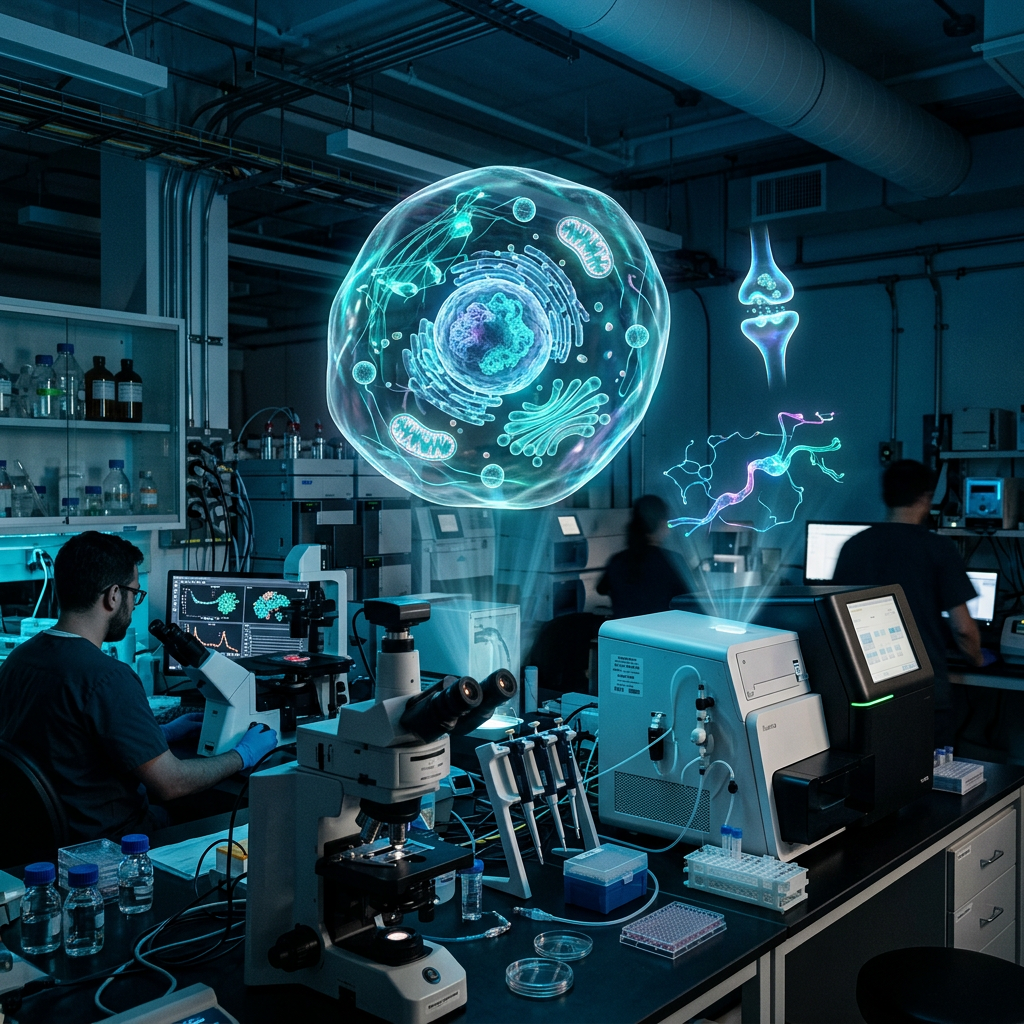
The phrase “virtual cell” can sound abstract, but the idea is fairly simple: build AI models that can predict how cells behave under different conditions. Instead of only running physical experiments, researchers could eventually ask a model what might happen when a cell faces a disease process, genetic change, immune signal, environmental stress, or potential intervention.
That does not replace real experiments. It changes how scientists decide which experiments are worth doing next. A useful predictive model could help narrow the search, reduce wasted effort, and point researchers toward biological mechanisms that might otherwise take years to find.
Biohub describes the Virtual Biology Initiative as an effort to build technologies and datasets needed for predictive models of life. The larger vision is not just to collect more data, but to make that data useful for AI systems that can help researchers ask better biological questions.
Why this matters for disease research
Many diseases begin at the cell level long before patients feel symptoms. Cancer, autoimmune disease, neurodegenerative disease, infection, metabolic disease, and rare genetic conditions all involve cellular systems behaving in ways that are difficult to predict. Scientists can study those systems, but biology is slow, complex, and expensive to map at scale.
A stronger biological data foundation could help researchers understand how cells respond to changes more quickly. That could eventually support better disease models, better targets, better diagnostics, and better ways to test ideas before moving deeper into the research pipeline.
The patient-facing takeaway is not that AI will replace doctors or scientists. It is that AI may become more useful in medicine when it is trained on the right kind of biological information. Without that foundation, even powerful AI models can only go so far.
Why the partners matter
This announcement stands out because it brings together groups that usually operate in different lanes. Biohub brings biomedical research infrastructure and AI biology work. DOE brings national lab capabilities, advanced measurement tools, modeling, computation, and exascale computing. NIH brings existing biomedical datasets, repositories, and research infrastructure. Google DeepMind, Isomorphic Labs, and Meta bring major AI investment and technical expertise.
Biohub also says major scientific institutions and consortia, including the Allen Institute, Broad Institute, Gladstone Institutes, Human Cell Atlas, Human Protein Atlas, and the Wellcome Sanger Institute, are involved in building the broader scientific community around the effort. NVIDIA is also supporting the initiative with accelerated computing infrastructure, domain-specific software, and technical expertise.
That matters because biological AI is not only a software problem. It is a measurement problem, a data standardization problem, a compute problem, a laboratory problem, and a collaboration problem.
The promise is big. The timeline is not immediate.
It is easy for AI in medicine to drift into hype. This story needs a more careful read. A $1.8 billion commitment does not mean a virtual cell already exists. It means researchers are trying to build the data foundation that could make more accurate virtual biology possible.
Reuters reported that the first large-scale dataset could be ready in about a year, with usable models possible within five years. Even then, researchers will still need to prove that the models can accurately predict real biological behavior and lead to useful discoveries in the lab.
That is why the most responsible way to understand this story is not “AI is curing disease.” It is: healthcare AI is entering the data-building phase that could make future disease research faster, more precise, and more predictive.

The access question
The word “open” is important here. If AI-ready biology data becomes locked inside only a few companies, the benefits could be limited. If the resource becomes genuinely useful to the broader scientific community, it could help more researchers ask bigger questions, including researchers outside the largest commercial labs.
Axios reported that Biohub’s Alex Rives described a one-year embargo period for commercial partners before data becomes more broadly available. That structure may help bring private partners into the effort while still moving the data toward wider scientific access.
That balance will be worth watching. The success of this initiative will not only depend on whether the data is large. It will depend on whether the data is high-quality, standardized, responsibly shared, and useful for researchers trying to answer real biological questions.
The bottom line
Biohub’s $1.8 billion AI biology data push is one of the clearest signs yet that healthcare AI is moving beyond chatbots and into the deeper infrastructure of science.
The big idea is simple: if AI is going to help researchers understand disease, it needs better biological data first. That means more measurements, more cell types, more conditions, better standards, stronger computing, and a research community that can actually use the data.
The future of AI in medicine may not begin with a model giving an answer. It may begin with scientists finally building the data layer that lets AI understand biology in the first place.
Want to stay informed on the latest in healthcare? Subscribe to the UpNEX Health blog and get notified when new articles are published!
FAQs
What is Biohub’s new AI biology initiative?
Biohub, DOE, NIH, Google DeepMind, Isomorphic Labs, Meta, and other partners are investing $1.8 billion in funding, data, computation, and measurement technology to build AI-ready biological datasets for predictive models of biology.
What is a virtual cell?
A virtual cell is the idea of a predictive model that can simulate how cells behave or respond to changes. The goal is to help researchers ask biological questions digitally, then use lab work to test and validate what the models suggest.
Does this mean AI can cure disease now?
No. This effort is about building the data foundation for future AI models in biology. It could help accelerate research, but it does not mean AI can currently cure disease on its own.
Why does AI need biological data?
AI models need large, high-quality datasets to learn patterns. Biology does not yet have a standardized, internet-scale dataset of how cells behave across many conditions, cell types, tissues, and interventions.
Who is involved in the $1.8 billion effort?
The effort includes Biohub, the U.S. Department of Energy, the National Institutes of Health, Google DeepMind, Isomorphic Labs, Meta, and other scientific partners and consortia.
What UpNEX Health category does this fit?
This fits best under AI in Healthcare, with secondary tags for Clinical Research, Healthcare Innovation, Healthcare Technology, AI Biology, and Digital Health.
Sources and References
Biohub. “International, Cross-Sector Collaboration Commits Nearly $2 Billion to Build Foundational Data for AI Models to Predict and Treat Disease.” Biohub, 7 October 2026, https://biohub.org/news/virtual-biology-initiative-expansion/.
U.S. Department of Energy. “DOE, NIH, and Biohub Partner to Build Foundational Data for Predictive Biological Super Intelligence Models.” Department of Energy, 7 October 2026, https://www.energy.gov/science/articles/doe-nih-and-biohub-partner-build-foundational-data-predictive-biological-super.
National Institutes of Health. “NIH Joins Effort to Build SI-Ready Data for Predictive Models of Human Biology.” NIH, 7 October 2026, https://www.nih.gov/news-events/news-releases/nih-joins-effort-build-si-ready-data-predictive-models-human-biology.
Hu, Krystal. “AI Wants to Cure Disease. It Needs Data First.” Reuters, 7 October 2026, https://www.reuters.com/technology/artificial-intelligence/ai-wants-cure-disease-it-needs-data-first-2026-10-07/.
Snyder, Alison. “Zuckerberg’s Biohub Teams With Google in Push to Map Cells.” Axios, 7 October 2026, https://www.axios.com/2026/10/07/zuckerberg-biohub-ai-biology-data.