One of the biggest medical research stories today is not about a new drug, device, or hospital system. It is about light.
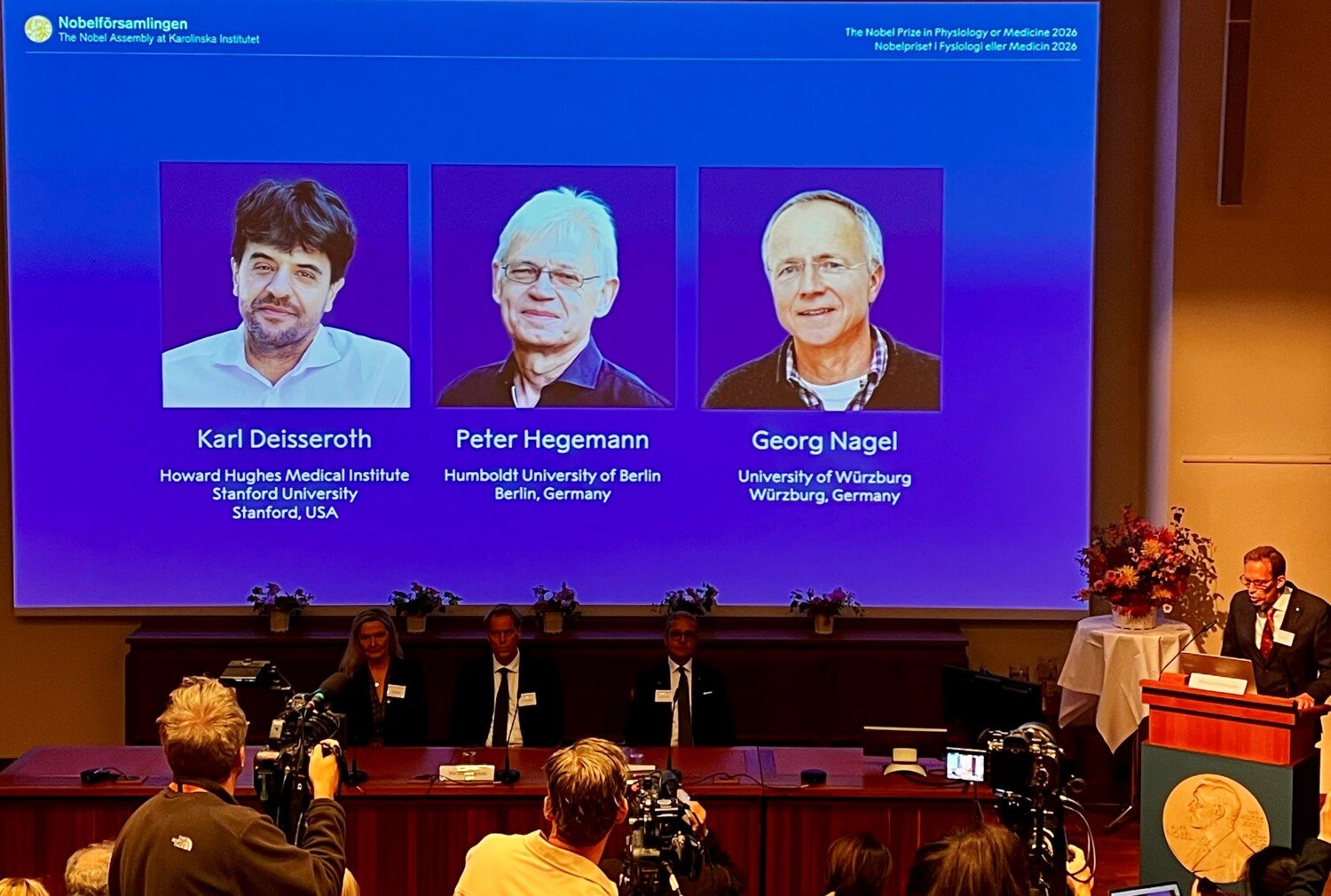
On October 5, 2026, the 2026 Nobel Prize in Physiology or Medicine was awarded to Karl Deisseroth, Peter Hegemann, and Georg Nagel for discoveries that helped create optogenetics, a technique that allows scientists to control specific nerve cells using light.
That may sound like science fiction, but it has become one of the most important tools in modern neuroscience. Optogenetics gives researchers a way to turn selected neurons on or off and then watch how that change affects memory, movement, emotion, behavior, and disease-related brain circuits.
The award matters because the brain is still one of medicine’s hardest puzzles. We can scan it, stimulate it, study it, and treat some of its diseases, but understanding exactly how specific cells create specific behaviors has been much harder. Optogenetics gave scientists a sharper tool. Instead of only watching brain activity, researchers could test what happens when a defined group of cells is activated or silenced.
This is why today’s Nobel Prize is not just a science award. It is a reminder that some of the biggest changes in healthcare start long before a treatment reaches a clinic.
The discovery started with algae
The story behind optogenetics starts with a tiny single-celled alga called Chlamydomonas. Peter Hegemann was studying how this organism swims toward light. That curiosity led to the discovery of channelrhodopsin, a light-sensitive protein that acts like a channel. When blue light hits it, charged ions flow through, creating an electrical signal.
According to Karolinska Institutet’s Nobel coverage, Hegemann and Nagel found that cells could become light-sensitive when this protein was introduced. Karl Deisseroth later transformed that idea into a tool for neuroscience by introducing the gene for channelrhodopsin into rat nerve cells. When those cells were exposed to blue light, they could be triggered to send a nerve signal.
That leap changed the field. Suddenly, researchers had a way to connect cell activity to behavior with far more precision than older methods allowed.

Why older brain tools were not enough
Before optogenetics, scientists had tools like electrical stimulation and drugs. Both were useful, but both had limits. Electrical stimulation could activate brain tissue quickly, but it often affected nearby cells and circuits too. Drugs could change activity, but they could spread widely and act too slowly to answer certain questions about fast brain signaling.
Stanford’s report on Deisseroth’s Nobel Prize explains the difference with a simple idea: what if researchers could install something like traffic lights in neurons and then start or stop signals with light? That is the power of optogenetics. It combines genetics, optics, and neuroscience to control defined cells or circuits with timing that matches how the nervous system actually works.
The result is a tool that does not just show that brain activity is associated with behavior. It helps researchers test whether certain cells or circuits are actually causing part of that behavior.
What optogenetics made possible
Optogenetics is now used in laboratories around the world to study how brain circuits shape memory, emotion, movement, social behavior, motivation, mood, addiction, and neurological disease. Researchers can use it to ask questions that once felt almost impossible: Which cells are involved in fear? Which circuits influence movement? Which pathways may be involved in depression, epilepsy, Parkinson’s disease, or addiction?
The important point is that optogenetics is mostly a research tool right now, not a routine clinical treatment. It has helped scientists understand the brain with more precision, but that does not mean patients are walking into clinics and having neurons controlled by light as standard care.
Still, the possible clinical directions are important. Karolinska Institutet notes that researchers are exploring optogenetics in attempts to restore sight in people with visual impairment. Other research paths have looked at how the technique could inform treatments for neurological and psychiatric disorders, even if many of those applications remain experimental.

Why this belongs in healthcare innovation
Healthcare innovation is often discussed as if it begins when a product launches. This Nobel Prize shows a different path. Sometimes innovation begins when scientists create a new way to ask better questions.
Optogenetics did not start as a polished healthcare product. It started with basic science, algae, ion channels, genetic engineering, and researchers trying to understand how living cells respond to light. Over time, that work became a tool that changed brain research and opened new ways to think about disease.
That matters for patients because many brain and mental health conditions are still difficult to explain at the circuit level. Depression, schizophrenia, Parkinson’s disease, epilepsy, dementia, chronic pain, addiction, and other conditions involve complex networks, not just one simple broken part. Tools that help researchers map those networks can eventually influence how diseases are understood, diagnosed, and treated.

The patient takeaway
For patients and families, the key takeaway is not that optogenetics is about to replace current brain treatments. It is that scientists now have a much more precise way to study how brain circuits work and how they break down in disease.
That distinction matters. A Nobel Prize does not mean a therapy is immediately available. It means the discovery has changed what researchers can do. In this case, it changed how researchers can investigate the living brain.
In medicine, that kind of shift can be powerful. Better tools can lead to better disease models. Better disease models can lead to better targets. Better targets can eventually lead to better diagnostics, devices, therapies, or patient care strategies.
Why the timing matters
The 2026 Nobel Prize arrives at a time when neuroscience is becoming more central to healthcare innovation. Brain disorders are some of the hardest conditions to treat, and mental health remains one of the largest unmet needs in medicine. At the same time, technologies like AI, advanced imaging, neuromodulation, genetic tools, and cell-specific research methods are pushing the field into a new era.
Optogenetics sits at the center of that shift because it helps answer one of the most basic questions in neuroscience: what does this specific group of cells actually do?
That question sounds simple, but it is not. The brain contains billions of neurons and trillions of connections. Being able to test defined circuits with light has given researchers a way to move from broad brain maps toward more precise cause-and-effect understanding.
The bottom line
The 2026 Nobel Prize in Physiology or Medicine recognizes a discovery that changed how scientists study the brain. Karl Deisseroth, Peter Hegemann, and Georg Nagel helped build the foundation for optogenetics, a method that uses light-sensitive proteins to control nerve cell activity with extraordinary precision.
The technology is not a simple cure or a quick clinical fix. Its biggest impact so far has been as a research tool that lets scientists ask better questions about brain circuits, behavior, and disease. But that is exactly why it matters.
Sometimes the future of medicine starts with a new treatment. Sometimes it starts with a new way to see the problem. Optogenetics gave neuroscience a new way to see, and control, the brain’s hidden circuitry.
Want to stay informed on the latest in healthcare? Subscribe to the UpNEX Health blog and get notified when new articles are published!
FAQs
Who won the 2026 Nobel Prize in Physiology or Medicine?
The 2026 Nobel Prize in Physiology or Medicine was awarded to Karl Deisseroth, Peter Hegemann, and Georg Nagel for discoveries related to light-gated ion channels and optogenetics.
What is optogenetics?
Optogenetics is a research method that uses light-sensitive proteins to control the activity of specific cells, especially nerve cells, using light.
Why is optogenetics important?
Optogenetics helps researchers test how specific nerve cells and brain circuits influence memory, emotion, movement, behavior, and disease-related processes.
Is optogenetics used as a routine medical treatment?
No. Optogenetics is primarily a research tool. Researchers are studying possible clinical uses, including vision restoration, but it is not a routine treatment for most patients.
How did algae lead to a brain research breakthrough?
Researchers studying algae discovered light-sensitive proteins called channelrhodopsins. Those proteins helped scientists create a way to make nerve cells respond to light.
What UpNEX Health category does this fit?
This fits best under Clinical Research, with secondary tags for Healthcare Innovation, Healthcare Technology, Neuroscience, Patient Education, and Brain Research.
Sources and References
Karolinska Institutet. “Shedding Light on the Brain’s Mysteries: The Nobel Prize Honours the Pioneers of Optogenetics.” Karolinska Institutet, 5 October 2026, https://news.ki.se/shedding-light-on-the-brains-mysteries-the-nobel-prize-honours-the-pioneers-of-optogenetics.
Stanford University. “Karl Deisseroth Awarded 2026 Nobel Prize in Physiology or Medicine.” Stanford Report, 5 October 2026, https://news.stanford.edu/stories/2026/10/karl-deisseroth-nobel-prize-physiology-medicine.
Reuters. “US and German Scientists Win Nobel Medicine Prize for Work on Light and Brain.” Reuters, 5 October 2026, https://www.reuters.com/business/healthcare-pharmaceuticals/deisseroth-hegemann-nagelwin-2026-nobel-medicine-prize-2026-10-05/.
Stanford Medicine. “Karl Deisseroth Shares Lasker Award for Research on Microbial Molecules Behind Optogenetics.” Stanford Medicine News Center, 24 September 2021, https://med.stanford.edu/news/all-news/2021/09/karl-deisseroth-lasker-award.html.